
When sales slow and cash gets tight, payroll is usually the largest cost an owner can control. Laying off employees in New Jersey is sometimes the right call, and it can be done lawfully. But many small business owners assume two things that aren’t true: that layoff laws only apply to big companies, and that at-will employment means they can let anyone go without risk.
Here is what actually applies to a business with fewer than 100 employees, including one with only a handful. It builds on our Employment Law & Compliance guidance for New Jersey employers.
The NJ WARN Act: Mostly a Big-Employer Law
New Jersey’s WARN Act, amended in April 2023, applies to employers with 100 or more employees nationwide, counting part-time staff. It is triggered when 50 or more New Jersey employees lose their jobs in a layoff or closing. Covered employers must give 90 days’ notice and pay severance of one week per year of service, plus four extra weeks if notice comes up short. Covered employers file notices through the NJ Department of Labor’s WARN portal.
If you have fewer than 100 employees, WARN almost certainly doesn’t apply to you. That spares you the notice and severance rules. It does not spare you from the law that causes most layoff lawsuits.
Which Laws Apply to Your Business
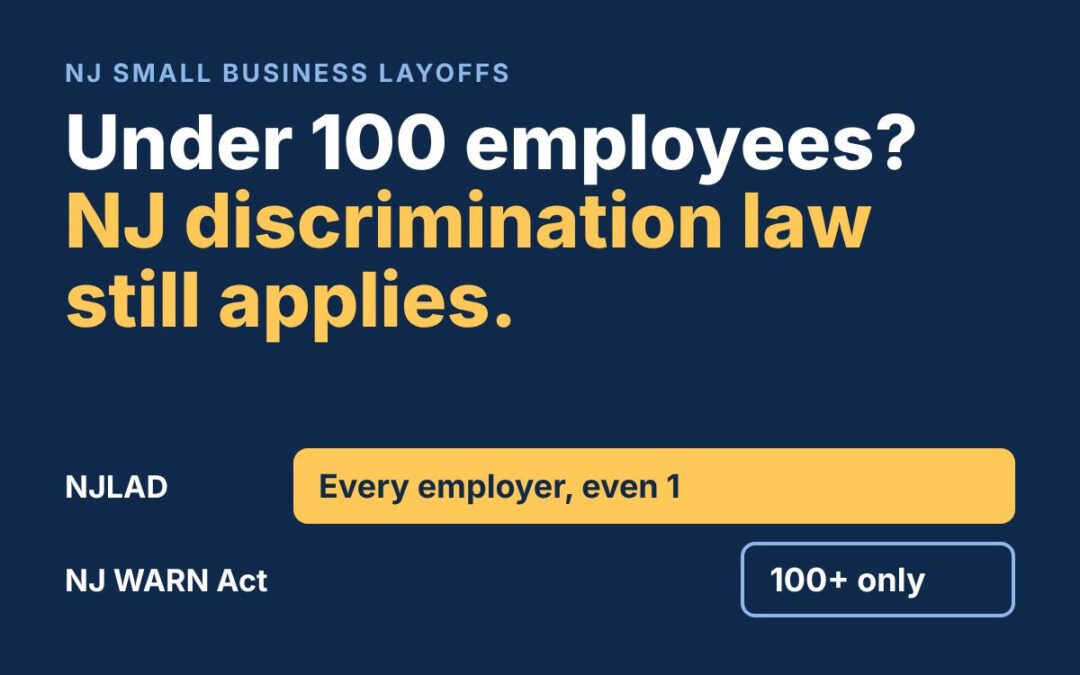
A two-person company escapes WARN and the federal statutes, but never the NJLAD.
At-Will Employment Has Limits
New Jersey is an at-will state. Without a contract, you can end someone’s employment for a good reason, a bad reason or no reason at all. What you can’t do is end it for an illegal reason, such as the person’s age, sex, race or national origin.
Your own paperwork can also limit at-will status. In Woolley v. Hoffman-La Roche, the New Jersey Supreme Court held that an employee handbook promising termination only “for cause” can be enforced like a contract unless it carries a clear, prominent disclaimer.
When the Role Has No Peers
Eliminating a one-of-a-kind job, such as your only bookkeeper or your sole sales manager, feels simple because there is no one to compare. In practice it is often the riskiest layoff. With no peer group, a court looks at what happened afterward: who picked up the duties, and whether you can prove the job was really eliminated.
In Sams v. Pinnacle Treatment Centers, a 58-year-old’s development role was cut in a claimed “restructuring,” and his duties went to a 39-year-old executive. The court sent his age discrimination claim to a jury, pointing out that the company could not produce a single email or memo showing the restructuring existed.
Disparate Treatment Is Recognized at Any Size
Federal discrimination laws have size thresholds: Title VII starts at 15 employees and the federal age law (ADEA) at 20. The New Jersey Law Against Discrimination (NJLAD) has none. It covers every employer in the state, regardless of headcount, and since 2021 it protects workers of any age from 18 up.
Disparate treatment means a protected trait played a part in who was chosen. Warning signs include laying off the oldest person in a group while keeping younger coworkers in the same role, or “eliminating” a job and then refilling it with someone younger a few months later.
Fines, Damages and Two Costly Lessons
The Division on Civil Rights can impose civil penalties of up to $10,000 for a first violation, $25,000 for a second within five years, and $50,000 for two or more within seven years. Penalties are usually the smaller cost. In court, an employee can recover back pay, front pay, emotional distress damages, punitive damages and attorneys’ fees, and the NJLAD has none of the damages caps found in federal law.
Lesson 1: A routine layoff, with younger peers kept. Robert Braden, 66, was laid off from Lockheed Martin in a 2012 reduction in force after about 29 years. Two younger employees with the same title kept their jobs, company witnesses gave different reasons for choosing him, and a year later the company hired a younger person for his position. In 2017, a New Jersey federal jury awarded about $1.56 million in lost wages and other compensatory damages, plus $50 million in punitive damages. The judge later threw out the punitive award, but the compensatory verdict and years of litigation remained. Lockheed is a giant, but the same facts could arise in a ten-person office, and the NJLAD would apply the same way.
Lesson 2: Severance didn’t make it safe. Stewart Zive ran a division of Stanley Roberts, Inc., a New Jersey luggage company. After a stroke, he managed the division from home. When he said he was ready to return, he was let go by phone with a severance package, and another employee took over his duties. A jury found disability discrimination and awarded $300,000. The company appealed all the way to the New Jersey Supreme Court and lost in 2005, about six years after the termination.
Before You Lay Anyone Off
- Write down the financial reason and the selection criteria before you choose names.
- For a sole position, document why the role, not the person, is no longer needed, and who will cover its essential tasks.
- Compare who stays and who goes by age, sex, race and other protected traits.
- If performance is a factor, rely on documented reviews, not memory. A consistent performance management process makes that possible.
- Check timing against recent leave, complaints or accommodation requests.
- Review your handbook and offer letters for language that limits at-will status. The paperwork from onboarding matters here too.
- Offer severance in exchange for a signed release reviewed by counsel.
- Keep the explanation consistent; a story that changes later looks like pretext.
Frequently Asked Questions
Yes. Eliminating a position for genuine business reasons is lawful under at-will employment. The risk is proof. Because there is no peer to compare against, document the financial reason before the decision, record who will absorb the duties, and be cautious about refilling the role soon afterward.
Not by law, unless a contract, handbook or past practice promises it. Many employers offer severance anyway in exchange for a signed release of claims. Two cautions: N.J.S.A. 10:5-12.8 makes nondisclosure clauses covering discrimination, harassment or retaliation claims unenforceable against the employee, and a release of federal age claims from a worker 40 or older (at an employer with 20 or more employees) must meet specific review-period rules to be valid.
Probably not. NJ WARN applies only to employers with 100 or more employees nationwide, counting full-time and part-time staff, and only when 50 or more New Jersey employees are terminated. A business below 100 employees has no WARN notice or severance obligation, though discrimination and wage and hour laws still apply, including paying final wages correctly. See The Hidden Price Tag of NJ Payroll Mistakes.
Planning a Reduction in Force?
A layoff decision made carefully protects both your business and the people affected. Get in touch with Marzano HR Consulting to review your selection criteria, documentation and severance approach before you act.