
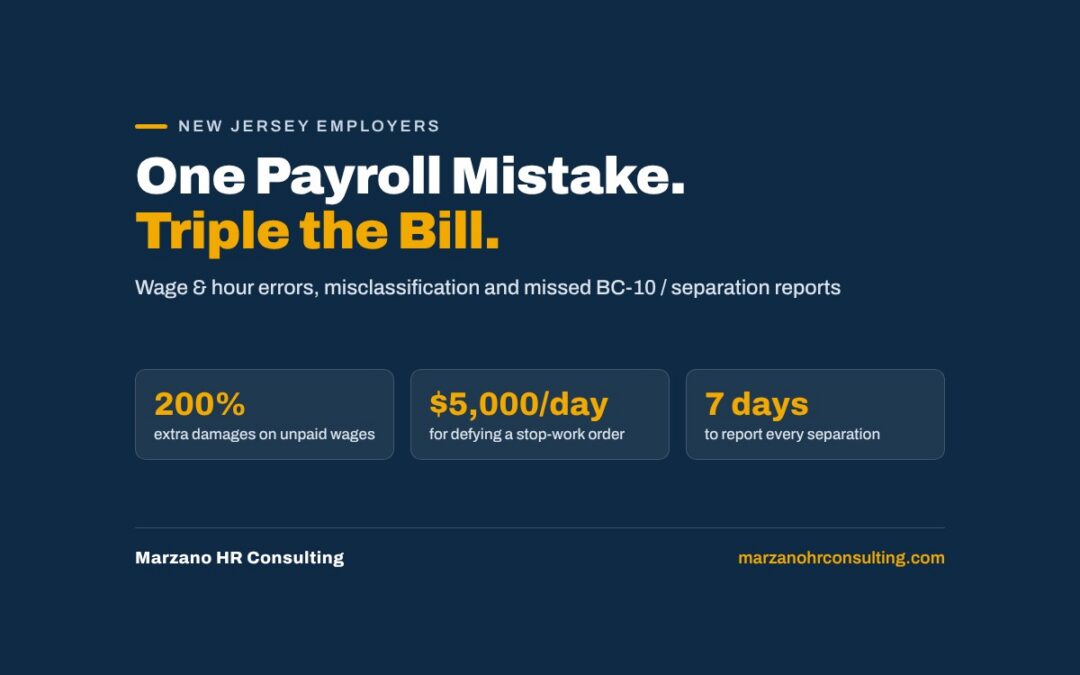
One payroll shortcut can cost a New Jersey business more than a year of professional HR support. New Jersey wage and hour penalties are among the toughest in the nation, and the state is actively enforcing them. Three areas trip up employers most often: pay practices, worker classification and the new rules for reporting employee separations.
New Jersey wage and hour penalties: you could owe triple
Under New Jersey’s Wage Theft Act, an employer can owe the unpaid wages plus liquidated damages of up to 200%. That is up to triple the original amount, before attorneys’ fees. Workers can also look back six years, not two, and sue as a group.
The most common causes are ordinary ones:
- Salaried staff treated as overtime-exempt when they do not qualify
- Off-the-clock work, such as pre-shift tasks or answering texts after hours
- Improper pay deductions or late final paychecks
State fines come on top of the damages. Repeated nonpayment can even become a criminal offense. A $10,000 overtime mistake can quickly become $30,000 or more.
Misclassification: a 1099 is not a shield
New Jersey presumes every worker is an employee unless the business proves all three parts of the “ABC test.” New NJDOL rules took effect October 1, 2026 (NJDOL announcement). They confirm that a 1099, a contractor agreement or the worker’s own LLC does not settle the question.
Get it wrong and the costs stack up:
- Up to $250 per misclassified worker for a first violation, and up to $1,000 per worker after that
- An extra penalty of up to 5% of each worker’s gross earnings for the prior 12 months, paid to the worker
- Back wages, overtime and the triple damages described above
- Unpaid unemployment, disability and family leave contributions and payroll taxes
- A state stop-work order that can shut down a job site, with fines of $5,000 per day for ignoring it
Separations: the BC-10 and the new 7-day portal deadline
Every time an employee leaves, for any reason, New Jersey employers have two duties.
- Give the employee Form BC-10. This applies to resignations, terminations, layoffs and retirements, whether the separation is permanent or temporary.
- Report the separation online within 7 days. NJDOL’s Employer Response Portal is now live, and you reach it through an Employer Access account. You must report every separation through it, even if the employee never files for unemployment.
Missing either step is costly. Willfully failing to provide required separation information carries a fine of $500 or 25% of the related benefits, whichever is greater. Each day can count as a separate violation. If you miss the 7-day window, the state may decide the claim without your side of the story. You can also lose the right to contest charges to your unemployment account, which can raise your tax rate.
The fix costs far less than the fine
Most of these penalties come from honest mistakes, not bad intent. A short compliance review can catch them before the state, or a former employee, does.
Marzano HR Consulting helps New Jersey businesses:
- Audit pay practices and overtime exemptions
- Test contractor relationships against the ABC test
- Build a simple offboarding checklist covering the BC-10 and portal reporting
Don’t wait for an audit letter. Contact Marzano HR Consulting at www.marzanohrconsulting.com to schedule your New Jersey compliance check today.
Frequently Asked Questions
Yes. Every separation has to be reported in the online portal within 7 days, and the employee still gets a BC-10.
Six years, plus up to 200% in extra damages and attorneys’ fees.
No. Under the ABC test, an agreement or a 1099 doesn’t decide whether someone is a contractor.