
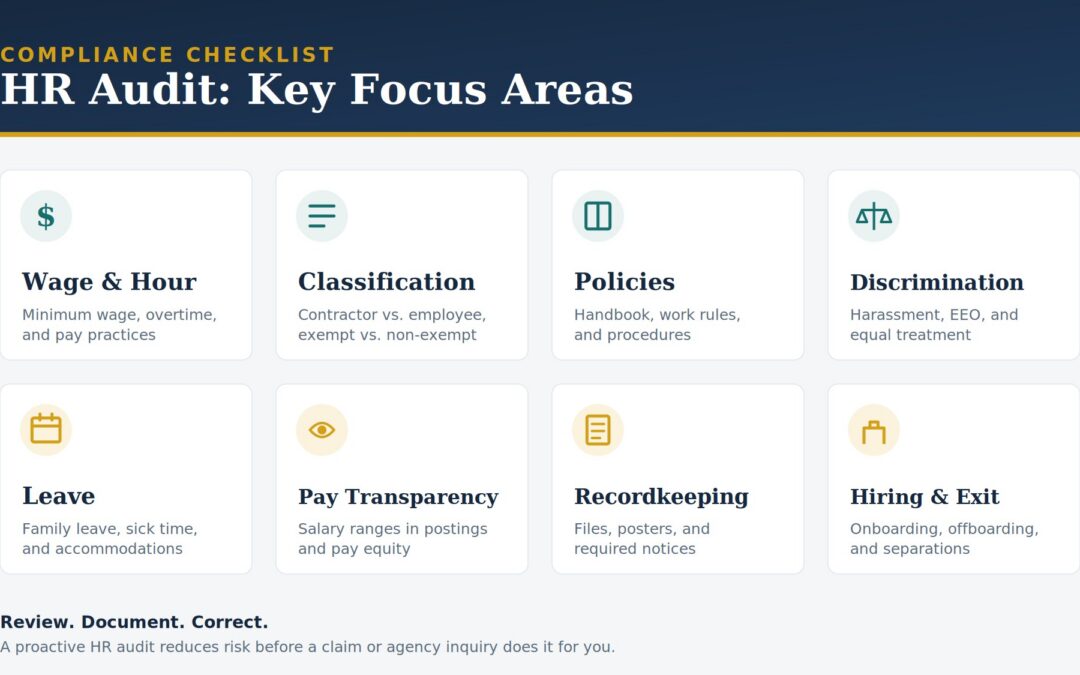
An HR audit is a structured review of your policies, practices, and records to confirm they still match the law. Over the past year, that law has moved a great deal, in both Trenton and Washington. As a result, policies that were fine in 2024 may quietly be out of step today, and most employers have no easy way to know which ones.
Why Now
New Jersey keeps adding employer obligations while federal agencies reverse course on major guidance. The gap between what your handbook says and what the law now requires tends to surface at the worst possible moment: after a complaint, a demand letter, or an agency inquiry. An HR audit is simply the cheaper way to find those gaps first.
What Changed in New Jersey
Several developments landed recently, and more will soon take effect. Each one raises questions that go well beyond a single policy line:
- A higher state minimum wage, now indexed to inflation
- New pay-transparency rules for job and promotion postings
- Mandatory electronic reporting of every employee separation
- Finalized independent-contractor (“ABC test”) regulations
- Expanding family-leave coverage and new scrutiny of AI in hiring
Whether any of these actually apply to your business, and how, depends on your size, your industry, and how the work is really performed. You can track the underlying rules through the New Jersey Department of Labor, but the harder question is what they mean for your particular workforce.
What Changed Federally
The federal picture shifted just as much. The U.S. Supreme Court’s Ames decision made it easier for any employee to bring a discrimination claim. The EEOC rolled back prior harassment guidance and put certain DEI programs under a microscope, while the NLRB and Department of Labor have signaled more aggressive enforcement, even in non-union workplaces. These shifts reach nearly every employer, but the right response varies widely from one company to the next.
What an HR Audit Can Cover
A thorough audit looks at documents, day-to-day practices, and records side by side, because the three tend to drift apart over time. Depending on your situation, it may touch areas such as:
- Wage, hour, and pay-equity practices
- Worker classification and exempt status
- Handbook, policies, and required notices
- Leave, accommodations, and anti-discrimination procedures
- Hiring, onboarding, and separation processes
That list is a starting point, not a checklist. The real value of an audit lies in deciding what to prioritize, how deep to go, and where your exposure actually is, which is difficult to judge from the outside.
Not Sure Where You Stand?
That is exactly the kind of question Marzano Human Resources Consulting helps New Jersey employers answer. We tailor the scope of each HR audit to your business and flag the issues that matter most for you. Reach out to talk through where your organization may be exposed, before someone else points it out for you.
Frequently Asked Questions
As a general rule, an annual review works well for most businesses, with additional check-ins whenever the law changes or your company grows, restructures, or enters a new state. That said, the right cadence and depth vary from one employer to the next, which is exactly the kind of thing we help New Jersey businesses figure out. To talk through what makes sense for your organization, call Marzano Human Resources Consulting at 973-513-9916.
An HR audit is a structured review of your policies, pay practices, records, and day-to-day procedures to confirm they still line up with current law. Nearly every employer can benefit from one, but the right scope depends on your size, industry, and how your workforce is structured. If you haven’t reviewed your handbook or classifications since before 2025, that’s usually a strong sign it’s time to take a closer look.
Both New Jersey and federal employment law shifted significantly in 2025–2026 — from new pay-transparency and separation-reporting rules to changes in how discrimination claims and independent-contractor status are treated. As a result, policies that were compliant a year ago may already be outdated. An audit is the most efficient way to catch those gaps before they surface through a complaint or an agency inquiry.