
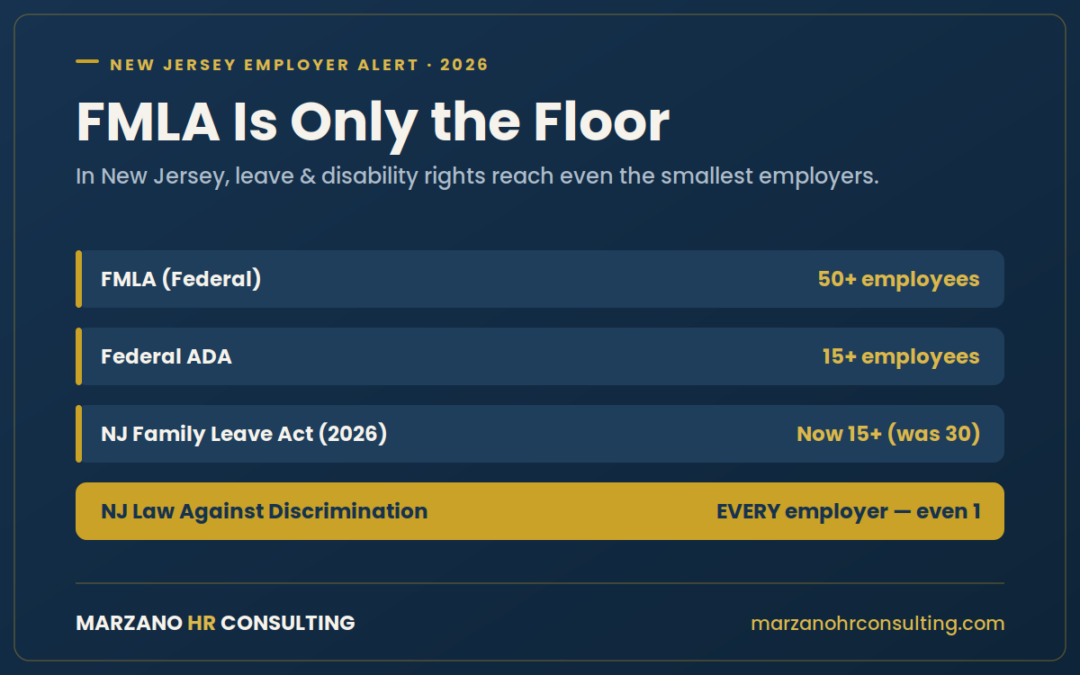
For years, small New Jersey business owners took comfort in a single number: 50. The federal Family and Medical Leave Act (FMLA) only requires employers with 50 or more employees to provide job-protected leave. So if you had 12, 25, or even 40 people, you assumed leave law simply didn’t apply to you.
In New Jersey, that assumption has quietly become one of the costliest mistakes an employer can make.
FMLA is still the federal floor — but the state has built a far stronger web of employee protections around it, and most of them don’t care how small you are.
A quick look at who’s actually covered
- NJ Law Against Discrimination (NJLAD): Applies to every employer in the state — even one with a single employee. It requires reasonable accommodations for disability and pregnancy and reaches further than the federal ADA, which only starts at 15 employees.
- NJ Family Leave Act (NJFLA): As of July 17, 2026, coverage dropped from 30 employees down to just 15 — and the threshold is set to fall further over the next two years. Eligibility is easier now, too, and new job-protection rights attach to employees using state benefits.
- NJ Temporary Disability & Family Leave Insurance (TDI/FLI): Your employees already pay into these programs, which replace up to 85% of wages — as much as $1,119 a week in 2026 — for their own medical leave or to bond with or care for family. And as of July 17, 2026, that time off now carries job protection, too: per NJDOL guidance, an employee collecting TDI can be entitled to up to 26 weeks of job-protected leave and one collecting FLI up to 12 weeks — with no minimum company size and no tenure requirement, starting their first day.
- Federal ADA: Still applies at 15+ employees and overlaps with NJLAD in ways that routinely trip up even seasoned managers.
Why this matters more than you might think
These laws don’t operate in neat, separate lanes. A single leave request can trigger FMLA, NJFLA, the ADA, NJLAD, and a TDI or FLI claim all at once. Handle any one piece wrong — a denied accommodation, a poorly timed termination, an outdated handbook, a missing notice — and the exposure in back pay, penalties, and litigation can dwarf the cost of simply getting it right up front.
The bottom line: in New Jersey, “we’re too small for this” is no longer a defense. Whether you employ 8 people or 80, you need current policies, trained managers, and a compliant leave process that holds up under scrutiny.
Frequently Asked Questions
Often, several at once. A single leave request can trigger FMLA, the NJFLA, the ADA, the NJLAD, and a TDI or FLI claim simultaneously — each with its own eligibility rules, notice requirements, and deadlines. The safest move is to pause before responding: document the request, and confirm which laws are in play before you approve it, deny it, or attach any conditions. Because these laws overlap and run concurrently, a misstep on just one can create real liability — which is exactly the kind of situation worth a quick call before you act.
Yes. FMLA’s 50-employee threshold is only the federal baseline — it doesn’t get New Jersey employers off the hook. The NJ Law Against Discrimination applies to every employer in the state, even one with a single employee, and requires reasonable accommodations. As of July 17, 2026, the NJ Family Leave Act covers employers with just 15 employees (down from 30), with that number set to drop further in the next two years. And every NJ employee pays into Temporary Disability and Family Leave Insurance regardless of company size. In short, “we’re too small for this” is no longer a defense in New Jersey.
They’re two separate things that are easy to confuse. Temporary Disability Insurance (TDI) and Family Leave Insurance (FLI) are state wage-replacement programs — they pay a portion of an employee’s wages (up to 85%, capped at $1,119 per week in 2026) but do not, on their own, guarantee the employee’s job back. Job protection comes from laws like FMLA and the NJFLA, which require you to reinstate the employee to the same or an equivalent position. An employee may be entitled to the pay, the protection, both, or neither depending on the circumstances — and recent changes now extend job protection to more workers using state benefits. Coordinating the two correctly is where many employers slip up.
Not sure where you stand? A focused HR audit is the fastest way to find the gaps before an employee — or their attorney — does.
That’s where we come in. Marzano HR Consulting helps New Jersey’s small and midsize employers navigate exactly this maze — practically, and within your budget. Contact us for a no-cost consultation.