
After more than a year of delay and significant pushback from the business community, the New Jersey Department of Labor (NJDOL) has officially adopted its final regulations implementing the state’s ABC Test for worker classification. The message to New Jersey employers is unmistakable: the state remains firmly committed to cracking down on worker misclassification, and businesses have a narrow window to get their classifications right.
The new regulations are expected to be published in June 2026 and take effect on October 1, 2026. Every New Jersey business that engages independent contractors, 1099 workers, freelancers, or gig workers should be reviewing their classifications now.
What Is the New Jersey ABC Test?
The ABC Test is the legal standard used to determine whether a worker is an employee or an independent contractor under New Jersey’s Wage and Hour Law, Wage Payment Law, Unemployment Compensation Law, and related statutes.
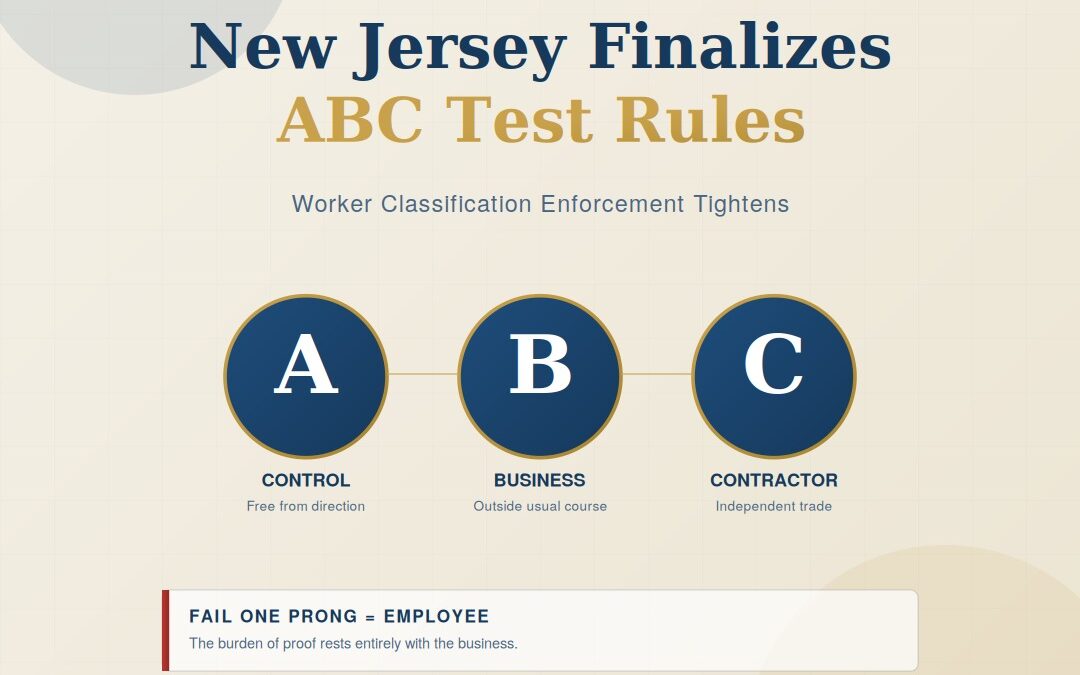
Under the ABC Test, a worker is presumed to be an employee unless the hiring business can prove all three of the following:
- (A) Control: The worker is free from the company’s control and direction, both under the contract and in actual practice.
- (B) Outside the Usual Course of Business: The work is performed either outside the usual course of the company’s business or outside all of its places of business.
- (C) Independent Trade or Business: The worker is customarily engaged in an independently established trade, occupation, profession, or business.
If even one prong fails, the worker is an employee — regardless of any 1099 form or written contractor agreement.
What Changed in the Final Rule
The final rule reflects a more measured approach than the 2025 proposal, but the fundamental framework remains intact. Key revisions include:
- Removal of industry-specific examples that had singled out rideshare drivers, drywall installers, and delivery drivers
- Legal compliance is no longer evidence of control — important for regulated industries
- Mandatory software/app use is no longer treated as automatic control
- A worker’s home is not automatically the employer’s place of business — a critical clarification for remote workforces
What Did NOT Change
Despite the refinements, the core of New Jersey’s classification regime remains tough on employers:
- The burden of proof rests entirely on the business
- The analysis is fact-driven, not formalistic — a written agreement or 1099 alone is not enough
- Prong B remains the hardest to satisfy — if a worker performs the same core services that define your business, the rule offers little relief
New Jersey’s Enforcement Commitment Is Real
This rule adoption is a clear signal that New Jersey intends to enforce its classification laws aggressively. Since 2021, the NJDOL has:
- Assessed over $10.6 million in misclassification penalties, paid to more than 12,500 misclassified workers
- Issued stop-work orders nearly 200 times
- Pursued back wages, unpaid unemployment contributions, and tax liabilities
The codified ABC Test gives the NJDOL even sharper enforcement tools.
What New Jersey Employers Should Do Now
Before October 1, 2026, every NJ business that uses independent contractors should:
- Audit your workforce against all three prongs of the ABC Test
- Update contractor agreements to reflect the working relationship
- Document independence — multiple clients, business registrations, own tools, invoices, advertising
- Train HR and management on control vs. independence
- Reclassify when necessary — before the state does it for you
- Consult experienced employment counsel
The Bottom Line
The final ABC Test rule is clearer, but it is not friendlier. New Jersey is not making independent contractor classification easier — it is making the rules tighter and enforcement stronger. Businesses that wait until October 1, 2026, are taking on significant and unnecessary legal exposure.
If you have questions about your worker classifications or need help reviewing your independent contractor agreements, Marzano Human Resources Consulting is here to help. Contact our office today.
Frequently Asked Questions
Q: What is the New Jersey ABC Test? The ABC Test is the legal standard New Jersey uses to determine whether a worker is an employee or an independent contractor. A worker is presumed to be an employee unless the business can prove all three prongs: (A) the worker is free from the company’s control, (B) the work is outside the company’s usual course of business, and (C) the worker runs an independently established trade or business.
Q: Does having a signed independent contractor agreement protect my business? No. A written contract, a 1099 form, or calling someone a “contractor” does not override the ABC Test. New Jersey looks at the actual working relationship, not the paperwork. The burden is on the business to prove all three prongs.
Q: Which New Jersey businesses are most at risk? Any business that relies heavily on independent contractors is at risk — including construction, trucking, delivery, rideshare, healthcare staffing, insurance, financial services, beauty and salon businesses, cleaning services, and gig-economy platforms. Industries where contractors perform the same core service the business sells (Prong B) face the highest exposure.